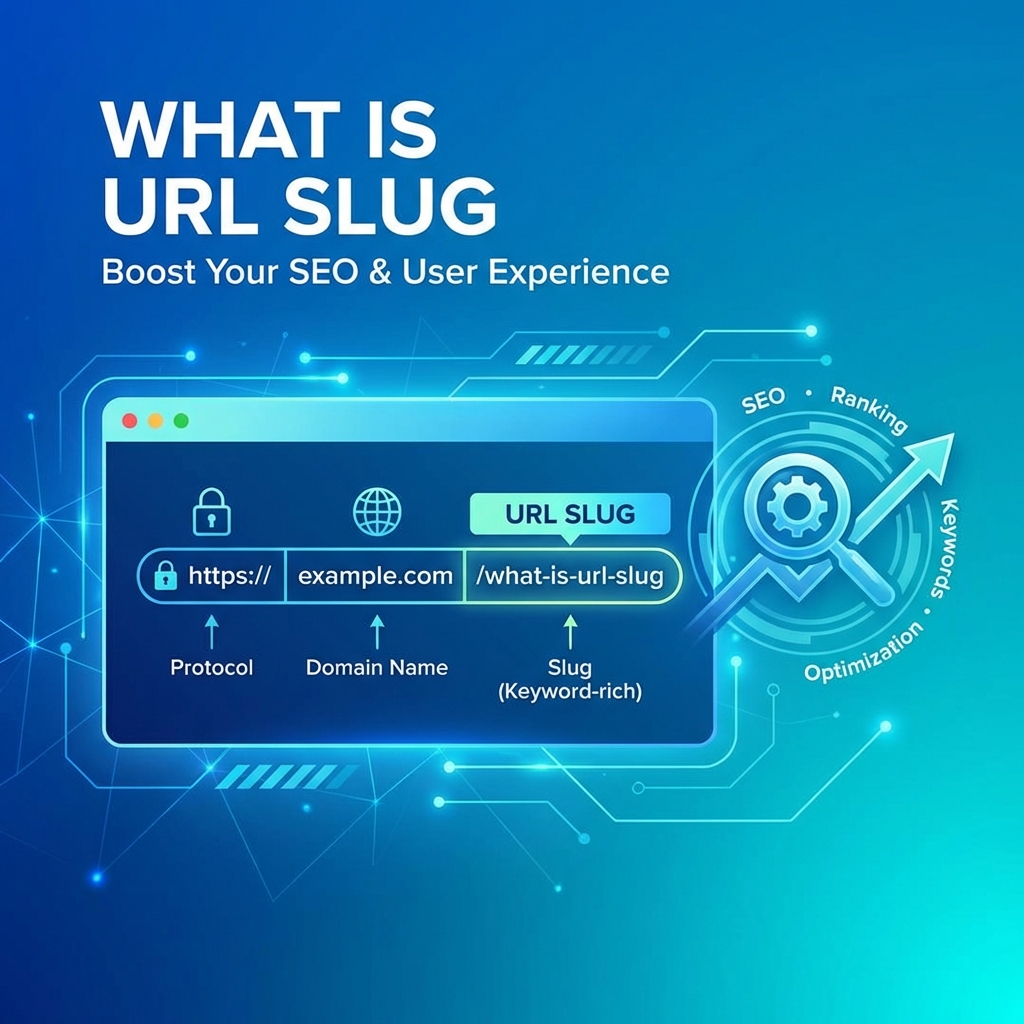
If you've ever wondered how professional websites create those clean, readable URLs, you're about to discover the secret. A slug generator transforms messy text into pristine web addresses that both search engines and humans love.
Think about the last time you shared a link with someone. Did it look professional and trustworthy, or was it a confusing jumble of numbers and symbols? The difference between "example.com/p=12345&cat=9" and "example.com/complete-guide-to-baking" isn't just aesthetic. It's the difference between a URL that gets clicked and one that gets ignored. That's exactly why we built our free Slug Generator tool - to help you create professional URLs every single time.
A slug generator is your personal URL craftsman. It takes whatever text you throw at it - whether that's "How to Bake the Perfect Chocolate Cake!" or "10 Tips für Anfänger (Beginners)" - and instantly transforms it into something web-friendly. The tool handles all the technical details that make URLs work properly across every browser, server, and platform imaginable.
Understanding URL Slugs
Before we dive deeper into slug generators themselves, let's clarify what we're actually talking about when we say "slug." In web development terminology, a slug is the part of a URL that identifies a particular page in an easy-to-read format. It's what comes after your domain name and any directory paths.
For instance, in the URL "myblog.com/how-to-train-your-dog," the slug is "how-to-train-your-dog." It tells both visitors and search engines exactly what they'll find on that page before they even click. This isn't rocket science, but it's surprisingly important for your website's success.
Here's something most people don't realize: search engines have used URL structure as a ranking factor for years. When Google's algorithms scan your page, they look at every signal they can find to understand your content's topic and quality. Your URL slug is one of those signals. A well-crafted slug containing relevant keywords gives search engines immediate context about your page.
Why Manual Slug Creation is Problematic
You might think creating URL slugs manually isn't that hard. Just take your title, make it lowercase, replace spaces with hyphens, and you're done, right? Well, not quite. The reality is far more complex.
What happens when your title contains special characters like apostrophes, quotation marks, or ampersands? What about accented letters from other languages? How do you handle multiple consecutive spaces or leading and trailing spaces? And what if your content management system has specific requirements for URL formatting that differ from standard conventions?
Manual slug creation becomes tedious quickly. Worse, it's error-prone. Miss one special character, forget to remove one extra space, or accidentally include an uppercase letter in the wrong place, and you've created a URL that might not work properly or could cause duplicate content issues down the line.
Professional web developers know this pain intimately. Before automated tools became common, they'd spend valuable time carefully constructing each URL, double-checking every character, and testing across different platforms. It was necessary work, but it certainly wasn't enjoyable or efficient. If you're curious about our story and why we created this tool, you'll see this frustration is what drove us to build a better solution.
How Slug Generators Work
Modern slug generators solve all these problems through automation. When you paste text into a slug generator, it performs a series of transformations in milliseconds. First, it converts everything to lowercase. This prevents issues with case-sensitive servers that might treat "Blog" and "blog" as different URLs.
Next, the generator handles special characters. Accented letters get converted to their plain equivalents - "café" becomes "cafe," "naïve" becomes "naive," and so on. This ensures universal compatibility. While modern web standards can technically handle Unicode characters in URLs, ASCII-only slugs remain the safest choice for maximum compatibility.
Punctuation and symbols get removed entirely. Exclamation points, question marks, quotation marks, parentheses, brackets, and other special characters serve no purpose in URLs and can actually cause problems. A good slug generator strips them all out automatically.
Spaces transform into hyphens, not underscores. This distinction matters more than you might think. Search engines treat hyphens as word separators but interpret underscores as word connectors. So "best-coffee-shops" gets read as three separate words, improving your chances of ranking for related searches, while "best_coffee_shops" might be seen as a single, unusual term.
Finally, the generator cleans up any mess created by consecutive hyphens or hyphens at the beginning or end of the slug. What started as "How to Start a Blog!!! (2026 Guide)" emerges as the clean, professional "how-to-start-a-blog-2026-guide."
The SEO Connection
Let's talk about why this matters for your search engine rankings. Google's algorithms have become incredibly sophisticated, but they still rely on basic signals like URL structure to understand and categorize content. When you use descriptive, keyword-rich slugs, you're speaking Google's language.
Consider two different URLs for the same blog post about JavaScript tutorials. Which one do you think provides better SEO value: "mysite.com/post?id=473829" or "mysite.com/javascript-tutorial-beginners"? The second option immediately tells search engines that this page contains JavaScript tutorial content aimed at beginners. The first option tells them absolutely nothing.
Beyond direct ranking factors, clean URLs improve click-through rates. When your page appears in search results, users can read the URL before deciding whether to click. A URL that clearly describes the content builds trust and sets accurate expectations. People are more likely to click "example.com/keto-diet-meal-plan" than "example.com/index.php?page=347&category=health."
Social media sharing amplifies this effect. When someone shares your link on Twitter, Facebook, or LinkedIn, the URL is often visible to everyone who sees the post. Clean, professional URLs make your content look more authoritative and trustworthy. They also make it easier for people to remember and manually type your URLs when needed.
Real-World Applications
Who actually needs slug generators? The answer is: anyone who creates web content. Bloggers use them daily when publishing new articles. Instead of accepting whatever auto-generated slug their CMS produces (which might be based on the post ID or a truncated version of the title), they craft perfect, SEO-optimized URLs. Check out our frequently asked questions to see how different professionals use slug generators in their workflows.
E-commerce managers rely on slug generators to create product URLs that customers can actually read and understand. "online-store.com/blue-cotton-t-shirt-medium" sells better than "online-store.com/products?sku=BL-COT-TSH-MED-001" because customers know exactly what they're looking at before they click.
Web developers building custom applications use slug generation logic to create clean routing structures. Whether they're working with React Router, Vue Router, or server-side frameworks, they need consistent, reliable URL generation. Professional slug generators provide tested algorithms they can trust.
SEO specialists working on site migrations or restructures process hundreds or thousands of URLs. They can't manually format each one. Slug generators allow them to batch process content, ensuring consistency across entire websites while maintaining best practices.
Common Misconceptions
Despite how useful they are, several myths persist about slug generators. Let's clear those up. First, some people think slug generators are only for technical experts. This couldn't be further from the truth. Modern slug generators are designed for absolute beginners. You don't need to understand HTML, CSS, or JavaScript. You don't need to know what ASCII characters are or how URL encoding works. You just paste text and get a result.
Another misconception is that all slug generators work the same way. While the end result is similar, different tools handle edge cases differently. Some are more aggressive about removing stop words. Others offer customization options for specific use cases. Quality generators follow web standards consistently, while poor ones might introduce inconsistencies or errors.
Some folks believe that SEO-friendly URLs are no longer important because search engines have become so advanced. This misses the point entirely. Yes, Google can understand content regardless of URL structure. But why make their job harder? Why not take advantage of every legitimate ranking signal available? Clean URLs remain a best practice recommended by Google's own webmaster guidelines.
Choosing the Right Tool
Not all slug generators are created equal. When evaluating options, consider several factors. First, does it handle all the transformations we discussed? Lowercase conversion, special character removal, accent handling, and proper hyphenation should all be standard features. Our Slug Generator handles all of these automatically, with zero configuration required.
Privacy matters too. Some slug generators send your text to remote servers for processing. This creates potential privacy concerns and dependency on internet connectivity. Client-side generators that process everything in your browser are generally preferable. Your content never leaves your device, and the tool works even offline.
Speed is another consideration. The best generators produce results instantly, in milliseconds. If you're waiting seconds for processing, either the tool is poorly coded or it's doing something unnecessarily complex behind the scenes.
Finally, think about ease of use. Can you simply paste text and click a button? Or do you have to navigate through multiple options and settings? For most users, simplicity trumps advanced features they'll never use.
Best Practices for Using Slug Generators
Even with an excellent slug generator, you should follow certain practices to get the best results. Start with good input. While generators can clean up messy text, giving them concise, descriptive titles produces better slugs. Think about your target keywords before generating. For detailed guidance, read our comprehensive user guide which covers all the best practices you need to know.
Review the output before implementing it. Generators follow rules, but rules don't account for every situation. Sometimes you'll want to manually edit the result. Maybe the generator kept a stop word you'd prefer to remove, or perhaps you want to shorten a particularly long slug. The tool gives you a great starting point, but your judgment makes the final decision. Learn more about advanced optimization in our best practices guide.
Keep slugs concise. While there's no strict character limit, shorter URLs are easier to remember, share, and type. Aim for three to five words that capture your content's essence. "ultimate-guide-to-advanced-seo-techniques-for-beginners" could probably become "seo-guide-beginners" without losing clarity.
Maintain consistency across your site. If you decide to include dates in slugs, do it consistently. If you prefer removing all stop words, apply that rule everywhere. Consistency builds user trust and helps search engines understand your site structure.
The Future of URL Slugs
Where are URL slugs headed? Despite predictions about the death of URLs in favor of newer standards, clean slug structures remain relevant. Voice search and AI assistants might change how people discover content, but they'll still need readable identifiers for that content.
If anything, the importance of clear, descriptive URLs is growing. As the web becomes more complex, simple conventions that make information findable and understandable become more valuable, not less. Slug generators will continue evolving to meet new challenges, but their core purpose remains unchanged.
Tools might add new features like automatic keyword extraction from content, integration with SEO analysis platforms, or AI-powered suggestions for optimal slug structure. But the fundamental value proposition stays the same: transform messy text into clean, web-friendly URLs that work everywhere and rank well. Have questions about slug generation? Feel free to reach out to us - we're always happy to help!